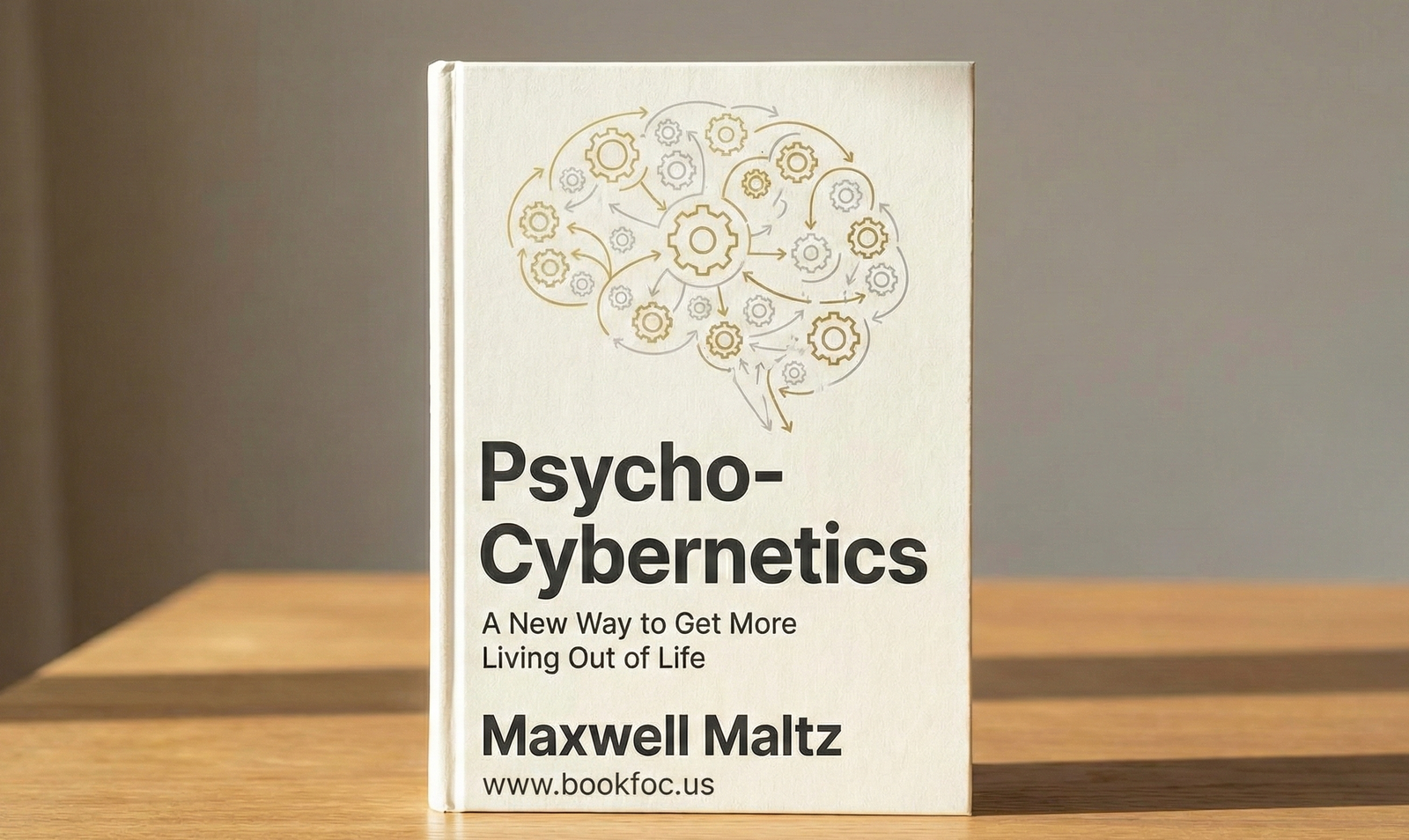
Key Lessons from Psycho-Cybernetics by Maxwell Maltz
Discover the transformative principles that have helped millions reprogram their minds for success. These lessons form the foundation of modern success psychology.
Lesson 1: Your Self-Image Is Your Blueprint for Success
The most fundamental principle in Psycho-Cybernetics is that your self-image determines your life outcomes. Your self-image is the internal picture you hold of yourself - the mental blueprint that governs how you behave, what you accomplish, and who you become.
Maltz discovered this principle through his work as a plastic surgeon. He noticed that patients who underwent successful physical transformations didn't automatically feel better about themselves. Their external appearance changed, but their internal image remained unchanged, resulting in continued feelings of inadequacy and shame.
Key Insight:
"You cannot permanently out-perform your self-image. If you unconsciously believe you're a 'C-student,' no amount of studying will consistently elevate you to A-level performance until you change your internal image."
How to Apply This:
Start by identifying your current self-image in key areas of life - career, relationships, health, and finances. What do you truly believe about yourself in each area? Write down the beliefs that limit you. Then, consciously work to upgrade your self-image through the techniques described in Lesson 3.
Lesson 2: Your Brain Is a Goal-Seeking Mechanism
Maltz uses cybernetics - the study of control and feedback systems - to explain how the human brain operates. Your brain is not passive; it's a sophisticated goal-seeking mechanism that automatically steers you toward the targets you set.
Think of your brain like a torpedo. Once you give it a target (a goal), it will zigzag through the water, making micro-corrections based on feedback. If the torpedo veers slightly left, it corrects. If it overshoots right, it adjusts again. Eventually, it hits the target with precision.
The Critical Principle:
"A human being is always a goal-striving mechanism. You are built to strive toward goals that you consciously or unconsciously provide to yourself."
The problem is that most people don't deliberately set goals; instead, they unconsciously focus on obstacles and failures. If you spend your day thinking "I'm going to fail," your brain dutifully works to make that happen with the same precision it would use to achieve success.
How to Apply This:
Stop focusing on what you want to avoid and start clearly defining what you want to achieve. Instead of "I don't want to fail," reframe it as "I am building a successful track record." Be specific. The clearer your mental target, the more efficiently your brain's servo-mechanism works toward it.
Lesson 3: The Theater of the Mind - Mental Rehearsal Changes Reality
This is perhaps the most powerful and practical lesson in Psycho-Cybernetics. Maltz discovered through extensive research that your nervous system cannot distinguish between a real experience and a vividly imagined experience.
Athletes have long used this principle. Before competition, elite performers close their eyes and mentally rehearse their performance in detail - feeling the movements, hearing the sounds, experiencing the success. By the time they perform in reality, their nervous system has already completed thousands of successful repetitions.
The Theater of the Mind Practice:
Duration: 15-30 minutes daily
Method:
- Find a quiet space and close your eyes
- Visualize yourself succeeding in vivid detail - not just seeing it, but feeling it
- Engage all five senses: What do you see? Hear? Feel? Smell? Taste?
- Experience the emotions of success - confidence, pride, joy
- Create "synthetic memories" by repeating the visualization consistently
Success Scars:
Maltz coined the term "success scars" to describe the mental imprints created by mental rehearsal. Just as scars are marks left by healed wounds, success scars are neural pathways etched into your brain by repeated visualization. These scars make real-world success feel natural and automatic.
How to Apply This:
Choose one area of life where you want to improve - public speaking, sales conversations, athletic performance, creative work. Spend 20 minutes daily visualizing yourself performing excellently. Make it real in your mind before you make it real in the world.
Lesson 4: The SUCCESS and FAILURE Mechanisms - Which Are You Operating?
Maltz identified that every person operates in one of two modes: a SUCCESS mechanism or a FAILURE mechanism. These aren't permanent states - you can switch between them - but one will be your dominant mode.
The SUCCESS Mechanism:
- Sense of Direction: You know where you're going and why
- Understanding: You grasp the bigger picture and how your actions fit
- Courage: You move forward despite uncertainty
- Charity/Compassion: You extend goodwill to others and yourself
- Esteem: You value yourself appropriately
- Self-Confidence: You believe in your ability to handle challenges
- Self-Acceptance: You embrace yourself as you are, while striving to improve
The FAILURE Mechanism:
- Frustrated/Fearful: You feel stuck and anxious about the future
- Aggressiveness (Misdirected): You channel frustration into negative actions
- Insecurity: You doubt your abilities and worth
- Loneliness: You feel isolated and disconnected
- Uncertainty: You're unsure about your direction and decisions
- Resentment: You feel bitter about circumstances or other people
- Emptiness: You feel a lack of purpose and meaning
How to Apply This:
Audit your current state. Which mechanism are you operating in right now? When you catch yourself in the FAILURE mode, actively shift to the SUCCESS mode by asking: "What direction am I moving in? What can I understand about this situation? Where can I show courage?" Small shifts in mindset create momentum toward the success mechanism.
Lesson 5: De-Hypnotize Yourself from Limiting Beliefs
Most people are "hypnotized" by false beliefs about themselves. These aren't facts - they're opinions that were planted in your mind, often by other people, and that you've accepted as truth.
A parent says, "You're not good at math." A teacher says, "You're shy." A sibling says, "You're the irresponsible one." Over time, you internalize these labels and they become your identity. You unknowingly organize your behavior to match these false conclusions.
The De-Hypnotization Process:
When you notice a negative thought or belief about yourself, pause and ask: "Why do I believe this? Is there actual proof, or have I simply accepted it as truth?"
In most cases, you'll realize that your limitations are based on conditioning, not on reality. You weren't born believing you're incompetent, shy, or unlovable - these are programs that were installed. And if they were installed, they can be uninstalled.
How to Apply This:
Start a belief audit. List the negative beliefs you hold about yourself. For each one, investigate its origin: Where did this come from? Is it true? What evidence contradicts this belief? Once you recognize a belief as just an opinion (not a fact), you've weakened its hold on you. From there, you can intentionally reprogram yourself with new, empowering beliefs.
Lesson 6: Your Past Doesn't Define You - Your Self-Image Does
One of the most liberating ideas in Psycho-Cybernetics is that your past mistakes, failures, and limitations do not have to define your future. What defines your future is your current self-image and the goals you're visualizing.
Many people are trapped by their history. They say, "I've always been bad at sales," or "I've never been in a successful relationship," or "I've always struggled with weight." These statements treat the past as a prophecy for the future.
But Maltz's research shows that the moment you change your self-image, your behavior automatically shifts. You become a different person - not magically, but naturally, because you're now operating from a new internal blueprint.
How to Apply This:
Stop using your past as evidence for your limitations. Instead, use your past as evidence for your capacity to grow and change. Every mistake you've made has taught you something. Every failure has prepared you for future success. Consciously reframe your past as the foundation for your future, not as proof that you can't change.
Lesson 7: The Power of Forgiveness - Let Go of Guilt and Shame
Implicit throughout Psycho-Cybernetics is the importance of forgiveness. Guilt, shame, and resentment are emotional anchors that keep you tied to your old self-image. They say, "I am the kind of person who did this bad thing," which becomes part of your identity.
To reprogram your self-image, you must first forgive yourself for past mistakes. This doesn't mean condoning poor behavior; it means releasing the emotional charge that keeps you stuck.
The Forgiveness Practice:
Acknowledge the mistake or failure, understand what you learned from it, and then consciously release it. Say to yourself: "I made a mistake. I've learned from it. I forgive myself. That is not who I am anymore." This frees up mental and emotional energy that was being consumed by guilt.
How to Apply This:
Make a list of past mistakes or failures you're still carrying guilt about. For each one, practice the forgiveness ritual above. Write a letter to yourself forgiving yourself for that mistake. The goal is to clear the emotional debris so you can build a new, positive self-image unburdened by shame.
Lesson 8: You Have a Success Mechanism - Learn to Operate It
Maltz's central premise is that you're not broken and you don't need fixing. You already have everything you need to succeed. What you need is knowledge - knowledge of how your mind works and how to consciously direct it toward your goals.
You're not a machine, but you have a machine inside you - your nervous system, your subconscious mind - that operates with mechanical precision. Just as you can learn to operate a car, a computer, or any other machine, you can learn to operate your own success mechanism.
The Three Steps to Operating Your Success Mechanism:
1. Set a Clear Goal - Know exactly what success looks like for you
2. Visualize the Success - Use your Theater of the Mind to create a vivid mental image of accomplishment
3. Trust the Process - Take action toward your goal, knowing that your subconscious mind is working in concert with your conscious efforts
How to Apply This:
Choose one important goal you want to achieve. Apply these three steps consistently over the next 30 days. Notice how your mind and behavior naturally align to support your goal. This is your success mechanism working.
The Big Picture: Your Self-Image Is Your Destiny
Psycho-Cybernetics teaches one fundamental truth: You are not limited by your circumstances, your past, or your natural talents. You are limited only by your self-image.
The beautiful part is that your self-image is not fixed. It's not something you inherited or something that happened to you. It's something you can consciously change through visualization, forgiveness, and deliberate mental practice.
By investing 15-30 minutes daily in your Theater of the Mind, by questioning your limiting beliefs, and by operating from your success mechanism, you can literally reprogram your destiny. The future you want is not a fantasy - it's a choice. And that choice begins with changing the image you hold of yourself.
Ready to Transform Your Self-Image?
Start with the visualization practice from Lesson 3. Commit to 20 minutes of daily mental rehearsal for the next 30 days, and notice the shifts in your confidence, your decisions, and your results.
For a complete understanding of how these principles work together, read the full Psycho-Cybernetics summary.
Follow @bookfocus_ for daily book wisdom that actually changes your life.
Comments 0
Loading comments...
No comments yet
Be the first to share your thoughts on this article!