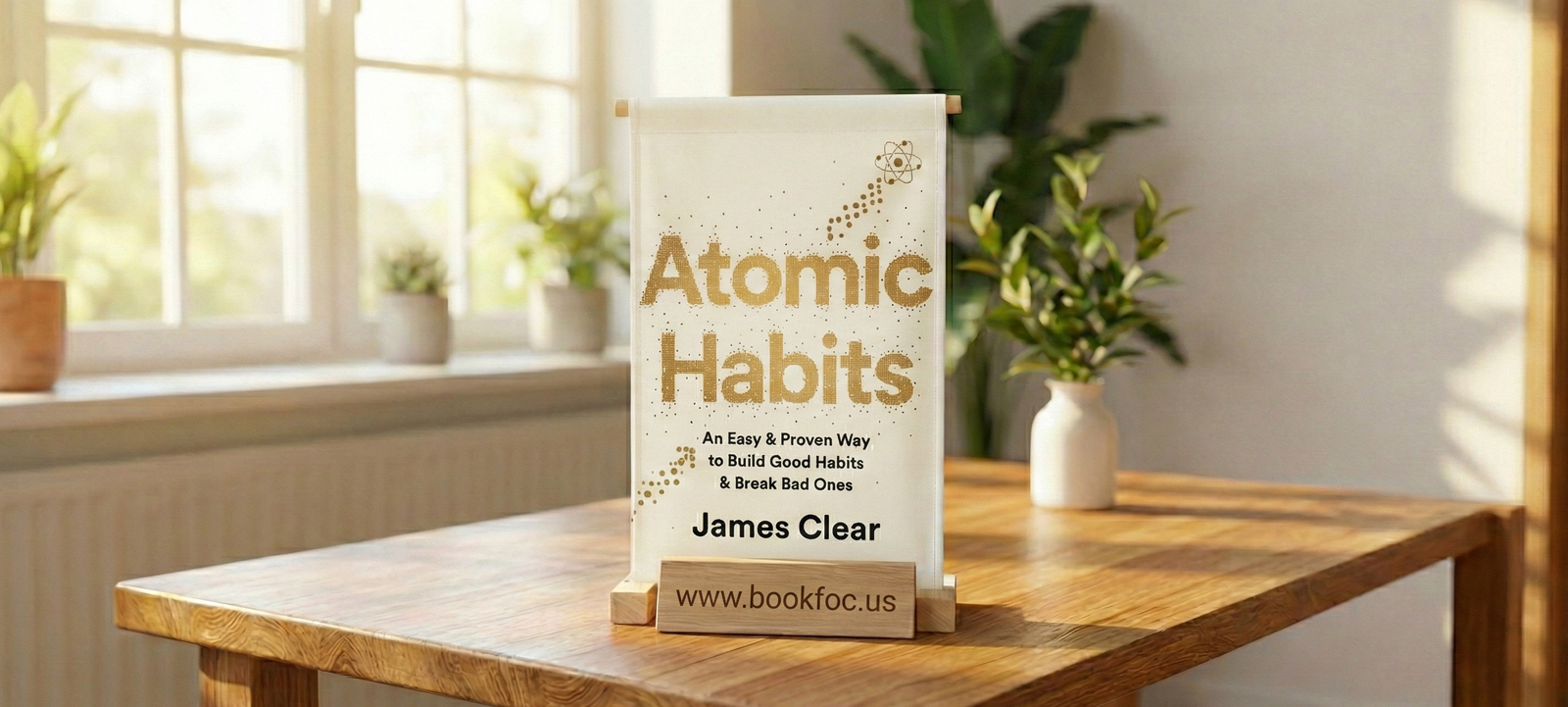
What if I told you that changing your life doesn't require massive overnight transformations?
James Clear's "Atomic Habits" revolutionized how millions of people think about personal change. The core message is simple yet profound: tiny changes lead to remarkable results.
Published in 2018, "Atomic Habits" has sold over 15 million copies worldwide and remains a #1 New York Times bestseller. It's not just another self-help book - it's a practical, science-backed framework for building good habits and breaking bad ones.
In this comprehensive guide, we'll break down everything you need to know about Atomic Habits, including the Four Laws of Behavior Change, practical strategies you can implement today, and real-world examples that prove small habits create massive results.
Table of Contents
- Who is James Clear?
- What is Atomic Habits About?
- The Core Philosophy: 1% Better Every Day
- The Four Laws of Behavior Change
- Identity-Based Habits: The Foundation
- Habit Stacking: The Implementation Strategy
- Environment Design: Making Habits Inevitable
- The Power of Habit Tracking
- How to Break Bad Habits
- Advanced Tactics for Habit Masters
- Real-World Success Stories
- Key Takeaways
- How to Apply Atomic Habits Starting Today
- Final Thoughts
Who is James Clear?
James Clear is a writer, speaker, and habit formation expert. His journey to becoming one of the world's leading authorities on habits began with a life-altering accident.
The Story That Changed Everything:
In high school, James was hit in the face with a baseball bat during practice. The injury was severe - his nose was broken in multiple places, and he suffered significant brain trauma. Doctors told him he might not play baseball again.
But through small, consistent improvements, James not only returned to baseball but became an Academic All-American and was named the school's top male athlete. This experience taught him the power of small habits compounded over time.
Key Achievements:
- Over 15 million copies of Atomic Habits sold worldwide
- Newsletter reaches over 2 million subscribers
- Featured in Time, The New York Times, Forbes, and more
- Speaks to Fortune 500 companies and world-class teams
- Created the Habits Academy online course
James's work focuses on the intersection of habits, decision-making, and continuous improvement. His writing combines scientific research with practical strategies, making complex behavioral psychology accessible to everyone.
What is Atomic Habits About?
"Atomic Habits" is a comprehensive guide to building good habits and breaking bad ones through tiny, incremental changes.
The Core Premise:
The book argues that you don't need radical change to transform your life. Instead, you need to focus on getting 1% better every day. These small improvements compound over time, leading to remarkable results.
What "Atomic" Means:
The word "atomic" has two meanings in this context:
- Tiny and small: Habits are the fundamental units of our larger systems. Just as atoms are the building blocks of molecules, tiny habits are the building blocks of remarkable results.
- Source of immense energy: Just as atoms contain enormous energy, small habits can have an enormous impact when compounded over time.
The Book's Structure:
Atomic Habits is organized around four main sections:
- The Fundamentals: Why tiny changes make a big difference
- The Four Laws: How to build better habits in four simple steps
- Advanced Tactics: How to go from good to great
- Making It Last: How to maintain habits for life
What Makes It Different:
Unlike other habit books that focus on motivation or willpower, Atomic Habits provides a proven framework backed by neuroscience, psychology, and real-world testing. It's not about what you should do - it's about how to make it easy to do it.
The Core Philosophy: 1% Better Every Day
The foundation of Atomic Habits rests on a simple mathematical truth: small improvements compound over time.
The Mathematics of Habits
The 1% Rule:
If you get 1% better each day for one year, you'll end up 37 times better by the end of the year.
Here's the math: 1.01^365 = 37.78
Conversely, if you get 1% worse each day for a year: 0.99^365 = 0.03
This demonstrates two critical truths:
- Small improvements accumulate into massive advantages
- Small declines accumulate into toxic disadvantages
The Valley of Disappointment
One of the most important concepts in the book is the Valley of Disappointment.
The Problem:
Most people expect linear progress. If they work hard for one week, they expect to see proportional results. When they don't see immediate results, they quit.
The Reality:
Habits work on a curve, not a line. You often spend weeks or months working hard without seeing results. This is the Valley of Disappointment - the gap between your expectations and reality.
Then, suddenly, you break through. The results appear all at once, even though the work was happening all along.
Real-World Example:
Imagine you're in a room that's slowly heating up. At 70°F, nothing happens. At 80°F, still nothing. At 90°F, nothing. Then, at 100°F, the water begins to boil.
The breakthrough moment isn't caused by the last degree of heat - it's the accumulation of all the degrees before it.
Forget About Goals, Focus on Systems
Clear argues that goals are about the results you want to achieve, while systems are about the processes that lead to those results.
The Problem with Goals:
- Winners and losers have the same goals (everyone wants to win the championship)
- Goals create an "either-or" conflict (you're either a success or failure)
- Goals restrict happiness (you delay happiness until the goal is achieved)
- Goals are at odds with long-term progress (once achieved, motivation drops)
The Power of Systems:
- Systems create continuous improvement
- Systems allow you to fall in love with the process
- Systems work whether you achieve the goal or not
- Systems create sustainable change
The Key Insight:
You do not rise to the level of your goals. You fall to the level of your systems.
The Four Laws of Behavior Change
The heart of Atomic Habits is the Four Laws of Behavior Change - a simple framework for building good habits and breaking bad ones.
Understanding the Habit Loop
Every habit follows a four-step pattern:
- Cue: The trigger that initiates the behavior
- Craving: The motivational force behind the habit
- Response: The actual habit you perform
- Reward: The end goal of the habit
The Four Laws work by optimizing each step of this loop.
The 1st Law: Make It Obvious
Core Principle: You can't build a habit you don't notice.
Implementation Strategies:
1. Implementation Intention
Instead of saying "I will exercise more," create a specific plan:
"I will [BEHAVIOR] at [TIME] in [LOCATION]."
Example: "I will meditate for 10 minutes at 7 AM in my bedroom."
Research shows that people who use implementation intentions are 2-3x more likely to follow through.
2. Habit Stacking
Link a new habit to an existing habit using this formula:
"After [CURRENT HABIT], I will [NEW HABIT]."
Examples:
- "After I pour my morning coffee, I will meditate for one minute."
- "After I take off my work shoes, I will immediately change into my workout clothes."
- "After I sit down for dinner, I will say one thing I'm grateful for."
3. Environment Design
Make the cues of good habits obvious in your environment.
Want to read more? Place books around your house where you spend time.
Want to practice guitar? Put your guitar in the middle of the living room.
Want to drink more water? Fill several water bottles and place them in obvious locations.
4. The Pointing-and-Calling Method
Borrowed from Japanese train conductors, this technique involves verbalizing your actions to increase awareness.
Before eating a meal, say: "I'm about to eat this. Will this make me healthier?"
Before buying something, ask: "Do I really need this?"
Breaking Bad Habits (Inversion):
Make It Invisible
Remove the cues of bad habits from your environment.
- Want to stop watching too much TV? Unplug it and put it in the closet after each use.
- Want to stop checking your phone? Leave it in another room.
- Want to eat healthier? Don't buy junk food in the first place.
The 2nd Law: Make It Attractive
Core Principle: You need to want the habit.
The Role of Dopamine
Dopamine is released not only when you experience pleasure, but also when you anticipate it. In fact, the anticipation of the reward drives behavior more than the reward itself.
Implementation Strategies:
1. Temptation Bundling
Pair an action you want to do with an action you need to do.
Formula: "After [HABIT I NEED], I will [HABIT I WANT]."
Examples:
- "After I get back from my run (need), I will watch Netflix (want)."
- "After I study for 25 minutes (need), I will check social media for 5 minutes (want)."
You can even combine this with habit stacking:
"After [CURRENT HABIT], I will [HABIT I NEED]. After [HABIT I NEED], I will [HABIT I WANT]."
2. Join a Culture Where Your Desired Behavior Is Normal
We pick up habits from the people around us. Join a group where:
- Your desired behavior is the normal behavior
- You have something in common with the group
Examples:
- Want to read more? Join a book club.
- Want to exercise? Join a gym or running group.
- Want to be more productive? Surround yourself with productive people.
3. Create a Motivation Ritual
Do something you enjoy immediately before a difficult habit.
Examples:
- Listen to your favorite song before working out
- Light a candle before starting deep work
- Make a special coffee before your morning routine
Over time, your brain will associate the ritual with the habit, making it more attractive.
Breaking Bad Habits (Inversion):
Make It Unattractive
Reframe your mindset to highlight the benefits of avoiding bad habits.
Instead of "I can't have junk food," say "I don't eat junk food. I'm someone who values health."
Instead of "I have to exercise," say "I get to build a strong body."
Language matters. It shifts your identity and makes the alternative unattractive.
The 3rd Law: Make It Easy
Core Principle: Reduce friction. Make good habits as easy as possible.
The Law of Least Effort
Human behavior follows the Law of Least Effort: we gravitate toward the option that requires the least amount of work.
This is why the path of least resistance shapes our habits more than our intentions.
Implementation Strategies:
1. The Two-Minute Rule
When you start a new habit, it should take less than two minutes to do.
The idea is to make it so easy you can't say no.
Examples:
- "Read before bed each night" becomes "Read one page."
- "Do 30 minutes of yoga" becomes "Take out my yoga mat."
- "Study for class" becomes "Open my notes."
- "Run three miles" becomes "Tie my running shoes."
The point is to master showing up. Once you've established the habit of showing up, you can improve and scale it up.
2. Reduce Friction for Good Habits
Decrease the number of steps between you and your good habits.
Examples:
- Want to exercise in the morning? Sleep in your workout clothes.
- Want to practice guitar? Keep it on a stand in the living room, not in the closet.
- Want to eat healthier? Meal prep on Sunday so healthy food is ready to eat.
3. Increase Friction for Bad Habits
Increase the number of steps between you and your bad habits.
Examples:
- Watching too much TV? Unplug it after each use and only plug it back in if you can name the show you want to watch.
- Spending too much time on social media? Log out after each use. Delete the apps from your phone.
- Playing too many video games? Unplug the console and put it in the closet after each use.
4. Use Commitment Devices
Make bad habits difficult in advance.
Examples:
- Ask your wife to change your social media passwords for the week
- Leave your credit card at home when going out
- Use website blockers to prevent access to distracting sites during work hours
Breaking Bad Habits (Inversion):
Make It Difficult
Increase the friction associated with bad habits.
The more energy required, the less likely you are to do it.
The 4th Law: Make It Satisfying
Core Principle: What is immediately rewarded is repeated. What is immediately punished is avoided.
The Cardinal Rule of Behavior Change
Behaviors that are immediately rewarded get repeated. Behaviors that are immediately punished get avoided.
The problem: Many good habits have delayed rewards (exercise, saving money, healthy eating), while bad habits provide immediate gratification (junk food, procrastination, overspending).
Implementation Strategies:
1. Use Immediate Rewards
Give yourself an immediate reward when you complete your habit.
The reward must:
- Be immediate (right after completing the habit)
- Be aligned with your identity (don't reward exercise with ice cream)
Examples:
- After a workout, track it on your fitness app (immediate satisfaction)
- After saving money, transfer $1 to a "vacation fund" you can see growing
- After studying, check off the session on your calendar
2. Make "Doing Nothing" Enjoyable
When avoiding bad habits, replace them with something you enjoy.
Examples:
- If you're trying to quit smoking, go for a walk when you get a craving
- If you're trying to stop watching TV, read an exciting book instead
3. Use a Habit Tracker
Habit tracking is powerful because:
- It makes the habit obvious (you see your progress)
- It makes the habit attractive (you want to keep the streak going)
- It makes the habit satisfying (checking off the habit feels good)
How to track habits:
- Use a simple calendar and mark an X each day you complete the habit
- Use a habit tracking app (Streaks, Habitica, Done)
- Use a journal or bullet journal
The Paper Clip Strategy: Start with two jars, one filled with 120 paper clips. Each day you complete your sales calls, move one clip to the other jar. Visual progress is motivating.
4. Never Miss Twice
Missing once is an accident. Missing twice is the start of a new habit.
If you miss a day, get back on track immediately. Don't let one bad day turn into two.
The first mistake is never the one that ruins you. It's the spiral of repeated mistakes that follows.
Breaking Bad Habits (Inversion):
Make It Unsatisfying
Create an immediate cost for bad habits.
Examples:
- Get an accountability partner who checks in on your progress
- Create a habit contract with stakes (if I don't go to the gym 3x this week, I donate $100 to a charity I don't like)
- Use apps that charge you money for breaking commitments (Beeminder, StickK)
Identity-Based Habits: The Foundation
One of the most profound insights in Atomic Habits is the concept of identity-based habits.
Three Levels of Change
There are three levels at which change can occur:
- Outcomes: What you get (losing weight, publishing a book, winning a championship)
- Processes: What you do (developing a new routine, decluttering your desk)
- Identity: What you believe (your self-image, judgments, biases, assumptions)
Most people focus on what they want to achieve (outcomes). But the most effective way to change is to focus on who you wish to become (identity).
Outcome-Based vs Identity-Based Habits
Outcome-Based:
- "I want to lose 20 pounds" (I want this)
- "I want to learn Spanish" (I want this)
- "I want to run a marathon" (I want this)
Identity-Based:
- "I'm the type of person who takes care of their body" (I am this)
- "I'm the type of person who learns new languages" (I am this)
- "I'm the type of person who doesn't miss workouts" (I am this)
Why Identity Matters
The goal is not to read a book, the goal is to become a reader.
The goal is not to run a marathon, the goal is to become a runner.
The goal is not to learn an instrument, the goal is to become a musician.
Your behaviors are usually a reflection of your identity.
What you do is an indication of the type of person you believe you are.
The Two-Step Process to Changing Your Identity
Step 1: Decide the type of person you want to be.
Ask yourself: "Who is the type of person that could get the outcome I want?"
Examples:
- Who is the type of person who could lose 40 pounds? A healthy person.
- Who is the type of person who could learn Spanish? A dedicated learner.
- Who is the type of person who could run a marathon? A consistent runner.
Step 2: Prove it to yourself with small wins.
Your identity emerges from your habits. Every action you take is a vote for the type of person you wish to become.
Examples:
- Want to be a writer? Write 100 words. You just cast a vote for "writer."
- Want to be healthy? Go for a walk. You just cast a vote for "healthy person."
- Want to be organized? Organize one drawer. You just cast a vote for "organized person."
The more votes you cast for a particular identity, the stronger that belief becomes.
Real-World Example
The Smoker Who Quit:
Imagine two people resisting a cigarette.
Person 1: "No thanks, I'm trying to quit."
Person 2: "No thanks, I'm not a smoker."
Person 1 still believes they are a smoker who is trying to be something else. They still view themselves through the lens of their old identity.
Person 2 has shifted their identity. They're not resisting smoking - they're simply acting in accordance with who they are.
Habit Stacking: The Implementation Strategy
Habit stacking is one of the most practical strategies in the book, and it's incredibly simple to implement.
The Concept
Habit stacking works by identifying a current habit you already do each day and then stacking your new behavior on top.
The Formula:
"After [CURRENT HABIT], I will [NEW HABIT]."
Why It Works
The key to creating a good habit is to identify a behavior you already do each day (a habit you don't have to think about) and then piggyback the new behavior onto it.
Your current habits are already built into your brain. By linking your new habits to a cycle that is already built, you make them easier to remember and execute.
Examples of Habit Stacking
Morning Routine:
- After I pour my coffee, I will meditate for one minute.
- After I meditate for one minute, I will write my to-do list for the day.
- After I write my to-do list, I will immediately begin my first task.
Exercise Routine:
- After I take off my work shoes, I will immediately change into my workout clothes.
- After I change into my workout clothes, I will do one push-up. (Two-Minute Rule)
Evening Routine:
- After I sit down for dinner, I will say one thing I'm grateful for.
- After I finish dinner, I will immediately put my dishes in the dishwasher.
- After I put my dishes away, I will wipe down the counter.
Creating Your Own Habit Stacks
Step 1: Brainstorm Your Current Habits
Make a list of things you do every day without fail:
- Wake up
- Brush your teeth
- Make coffee
- Eat breakfast
- Take a shower
- Get dressed
- Sit down at your desk
- Eat lunch
- End the workday
- Eat dinner
- Turn off the lights
- Get into bed
Step 2: List New Habits You Want to Build
Examples:
- Meditate
- Exercise
- Journal
- Read
- Call a friend
- Do pushups
- Stretch
Step 3: Match Them Up
Connect a new habit to a current habit using the formula: "After [CURRENT HABIT], I will [NEW HABIT]."
Advanced Habit Stacking
You can also stack multiple habits together to create a routine:
Morning Stack:
- After I pour my coffee, I will meditate for 60 seconds.
- After I meditate, I will write down three things I'm grateful for.
- After I write my gratitude list, I will read 10 pages of a book.
- After I read, I will exercise for 5 minutes.
This creates a chain reaction of positive behaviors, each one triggering the next.
Continue Your Habit-Building Journey
Want more practical strategies for building better habits? Check out our comprehensive guide: Atomic Habits: Build Better Habits, One Small Step at a Time
For daily book summaries, mindset shifts, and practical life advice, follow us on Instagram @bookfocus_
Let's build better habits together, one small step at a time. 📚
Have you read Atomic Habits? What's the one habit you're building right now?
Share your journey with us on Instagram @bookfocus_ and join a community of readers committed to continuous improvement.
Remember: You don't have to be perfect. You just have to be 1% better than yesterday.